Pharmacy Invoicing Automation
Lead Product Designer • Float
A billing automation system that introduced the After Visit Report (AVR) as the central unit of work, enabling automatic invoice sending and centralized nurse payment workflows for the Billing Team.
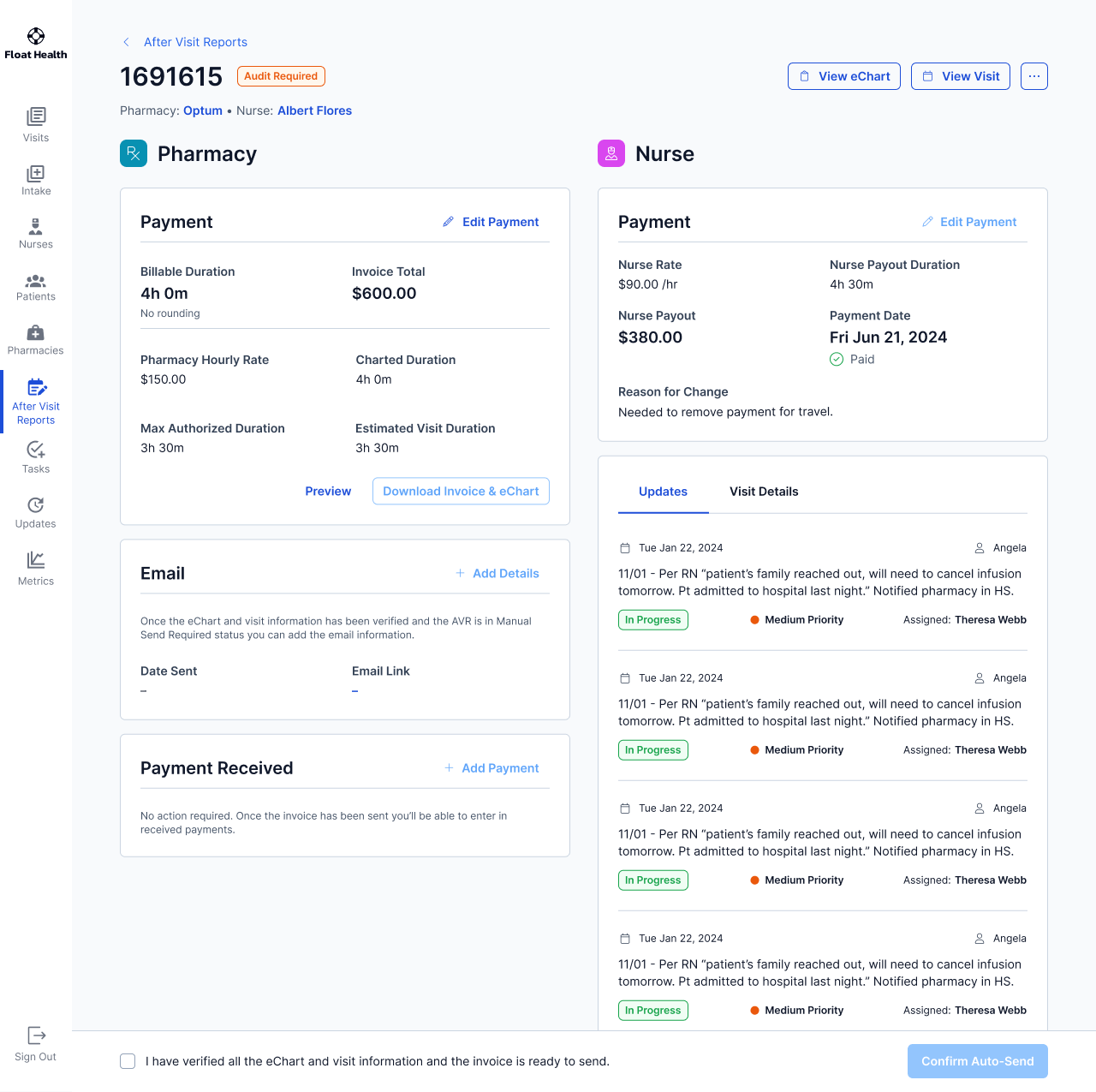
Automate invoicing from shift data to reduce operational work and support scaling with more pharmacy partners.
Float's invoicing process for pharmacies was manual and time-consuming, requiring teams to gather and verify shift data, which led to delays, errors, and increased operational overhead.
Understand the full invoicing lifecycle and identify scale constraints
Billing/Finance Team
By reviewing support tickets, internal processes, and stakeholder interviews, we validated that manual invoice creation was creating delays, errors, and unnecessary operational burden.
Pharmacies
In meetings with pharmacies, we successfully designed the invoice operation and delivery to meet their approved format requirements.
Validate automation priorities with operational data and Billing Team feedback
Approximately 85% of the pharmacies' invoicing processes were similar, so we focused mainly on them as our target candidate. The remaining processes had to be handled manually.
The current invoicing process relied heavily on manual review, hand-sent invoices, and informal coordination across tools, making it difficult to scale as visit volume increased.
- Candidate pharmacies accounted for ~85% of visits in late 2024
- Visit volume was projected to continue growing quarter over quarter
- Billing team feedback emphasized reducing routine work, not eliminating control
- Contract variance reinforced the need for both automated and manual paths
Introduce the AVR as the central unit of work for billing
The design introduced the After Visit Report (AVR) as the central unit of work for invoicing and nurse payment. The goal was to consolidate actions, make state explicit, and reduce context switching while supporting both automation and exception handling.
- Designed a dashboard to surface AVRs by status and highlight exceptions
- Centralized invoice review, sending, and nurse payment in one record
- Moved billing actions out of Visit records and deprecated manual trackers
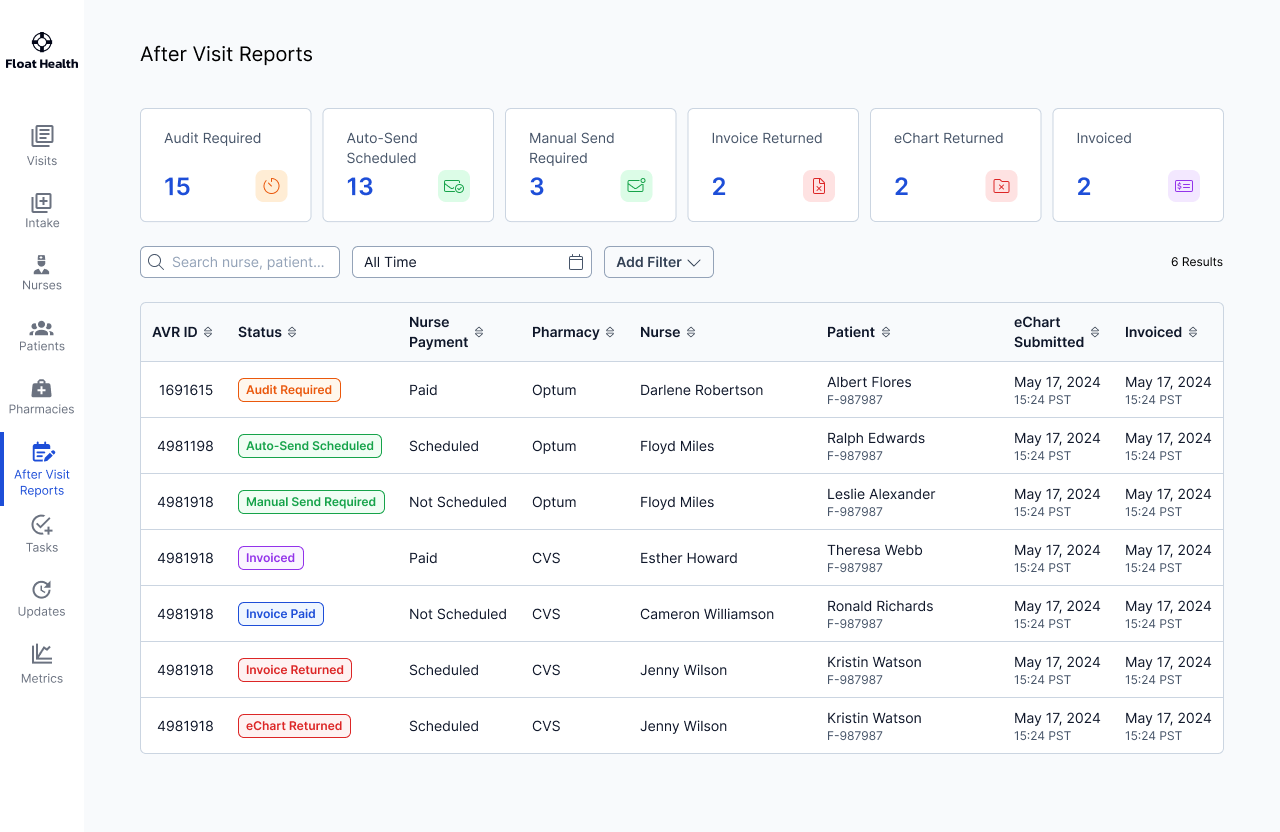
The AVR dashboard gives Billing one queue to manage: clear states, visible priorities, and fast triage for exceptions.
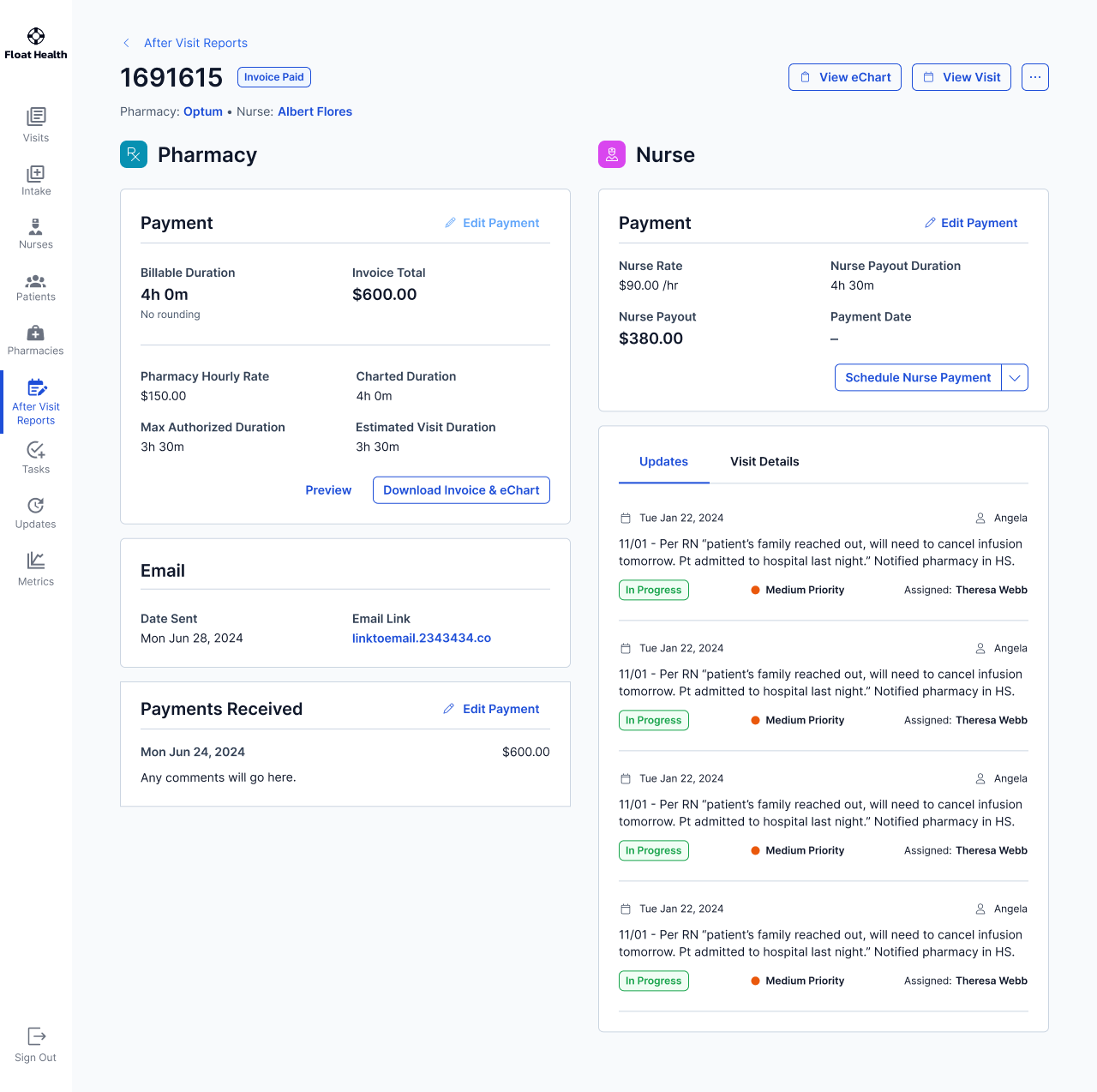
The operations team can view the complete status of pharmacy invoices and nurse payouts in one place, eliminating the need to track each part separately.
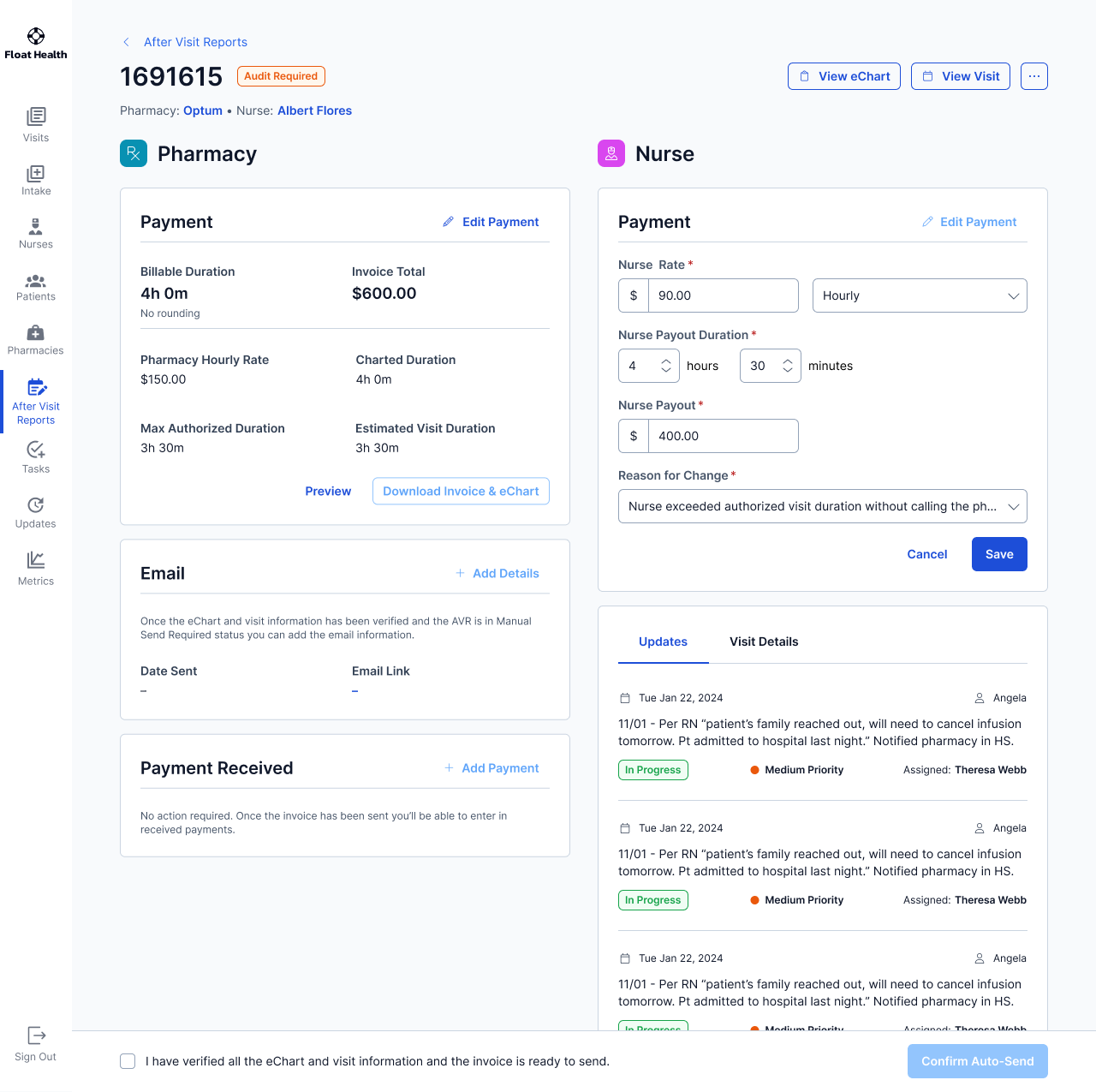
The invoice is automatically sent after the Ops team audits it. The invoice details, including the amount and when it was sent, are captured and preserved for easy review.
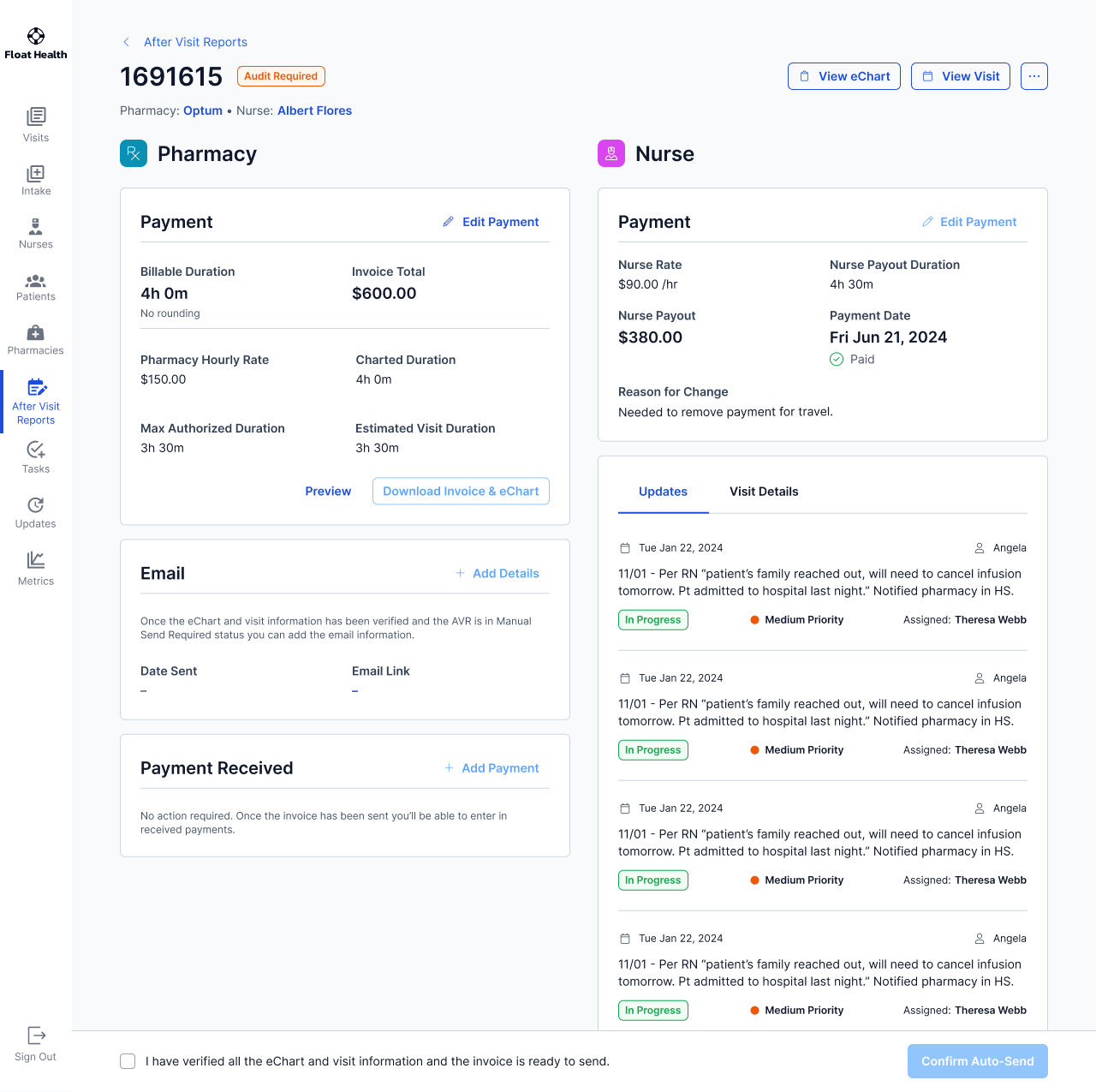
After the invoice is sent to the pharmacy, the ops team can promptly pay the nurse. This automatic process can be modified for any additional payments. All details and updates are recorded.
Measurable operational improvements and a foundation for future tooling
Invoicing Automation delivered measurable operational improvements while laying the foundation for future internal tooling.
- The automation significantly reduced manual work for the operations team and improved billing reliability helping the company get paid quicker.
- By removing operational bottlenecks, the company could onboard additional pharmacy partners without increasing administrative overhead.
- Transitioned additional pharmacies to automated invoicing, with new pharmacies eligible by default.
Automation enables focus on exceptions, not routine
Introducing the invoicing automation consolidated fragmented workflows and made billing state explicit. The feature-flagged rollout gave the Billing Team control during the transition, and the patterns established — dashboards, workflow state, automated vs. manual paths — became a durable foundation for future internal tooling.